
Change and be changed: Looking back at ten years of the soma design research program
Abstract
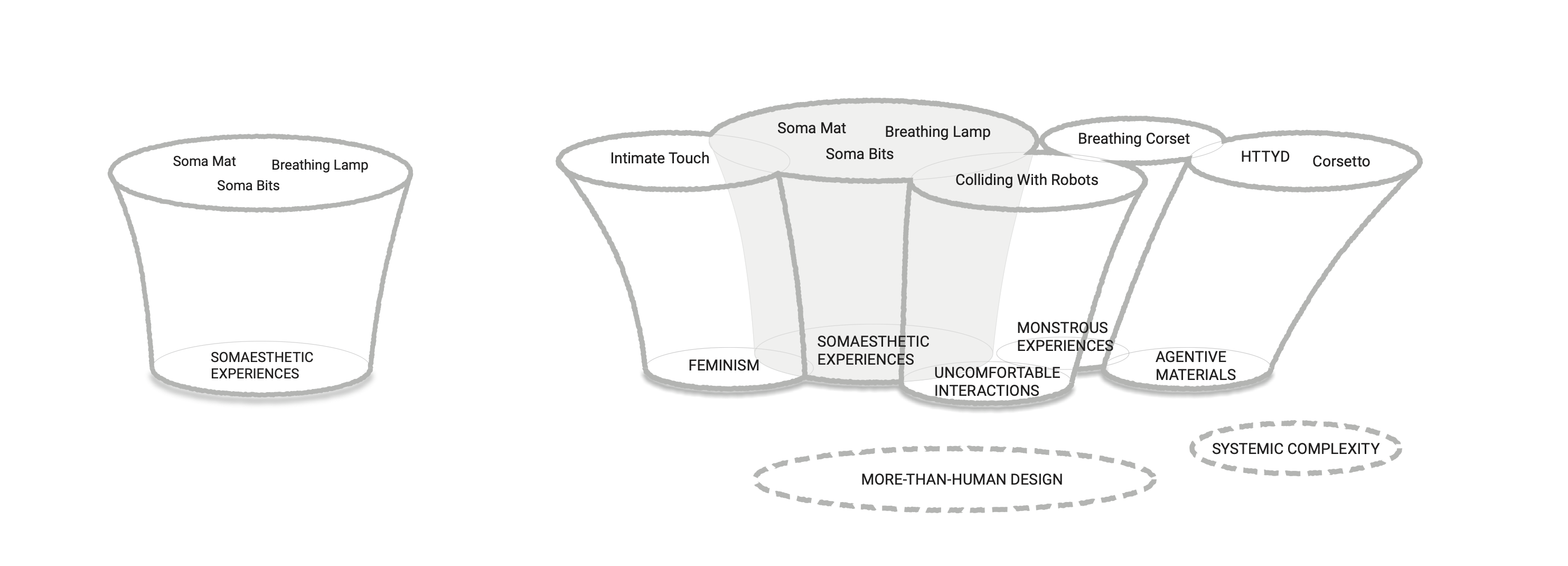
Soma design research at KTH in Stockholm, Sweden, originated over ten years ago as an interaction design research approach based on somaesthetic and feminist philosophy. Soma design is a first person approach to designing full-body interaction with the aim of deepening somaesthetic appreciation. Here, we analyze its development as a design research program, drawing on practical design examples as well as conceptual developments. Key insights for readers interested in soma design research and similar approaches concern: learning and appropriation as individual and meliorative processes; design representations including somatic and sympoietic materials and tools; and the scope of soma design research from a first person perspective towards the intersubjective and the systemic. A more general contribution, potentially relevant for all readers interested in programmatic design research, is an approach to assessing a program in terms of its generativity, transferability, and scope relative to an aesthetic worldview that the program both enacts and refines through intentional design work, tracing how both program and worldview drift over time.
Citation
Kristina Höök, Jonas Löwgren, Anna Ståhl. Change and be changed: Looking back at ten years of the soma design research program. ACM Trans. Computer-Human Interaction , doi:10.1145/3793670 , 2026.
Acknowledgements
All present and former co-workers contributing to the soma design research program at KTH. Johan Redström, Kristina Andersen, and Jeffrey Bardzell who graciously shared their time and insights with us at an early stage of the project. Based on their input, we decided to revisit the soma design research program based on its own premises. The work is funded by the Swedish Research Council (VR) under grant number 2021-04659.