

Reflections on Traceability for Visualization Research
Abstract
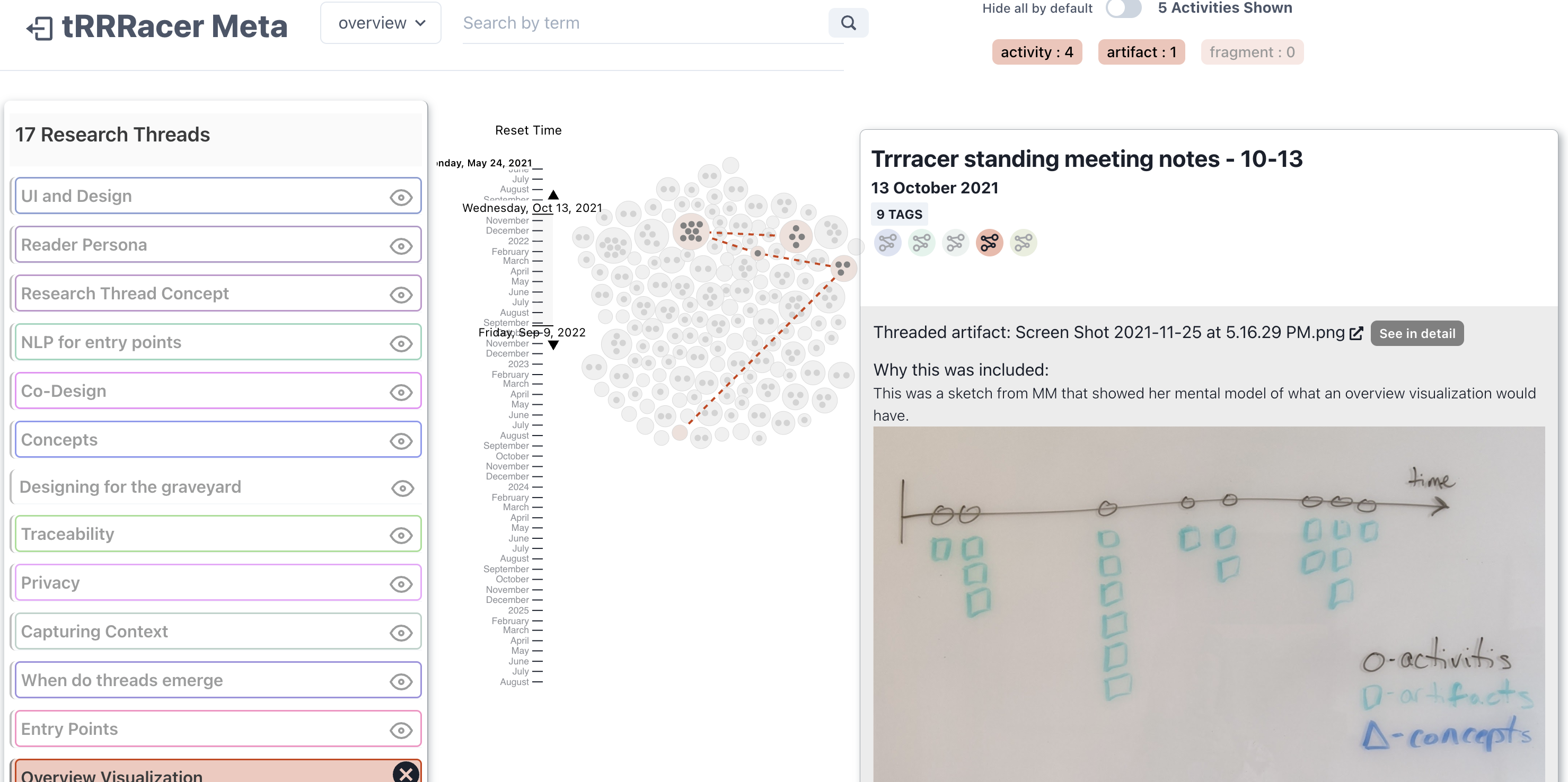
Decades of advocacy for reproducibility and replication have advanced open, transparent practices in the sciences. However, traditional notions of reproducibility fit poorly with design-oriented visualization research, where insights emerge through subjective, situated, and iterative work. So how can we ensure rigor and transparency in processes that are inherently unre- producible? To introduce transparency in design-oriented research, we propose to focus on traceability: surfacing the origin and development of research contributions based on rich sets of artifacts documenting the design process. We investigated traceability through a collaborative autoethnographic reflection that builds on several years of work exploring ways to make design-oriented research transparent. This exploration includes an experiment to build a tool to support traceablity, that we called tRRRacer. The tRRRacer tool provided a testbed for us to operationalize the three tenets of a traceable process: (1) Record abundant, annotated artifacts representative of research activities; (2) Report curated research threads that articulate rationale and evolution of the process, allowing others to (3) Read via interfaces that help retrace claims and assess plausibility. Reflecting on our experiences, we contribute a theorization of traceability and reflections on how we might support it.
Citation
Jen Rogers, Derya Akbaba, James Scott Brown, Alex Lex, Miriah Meyer. Reflections on Traceability for Visualization Research. Computer Graphics Forum (EuroVis) , doi:10.1111/cgf.70445 , 2026.
Acknowledgements
This work is funded in part by the Swedish Research Council (Grant No. 2024-05726); by the Wallenberg AI, Autonomous Systems and Software Program (WASP) funded by the Knut and Alice Wallenberg Foundation; and the U.S. National Science Foundation (NSF OAC 1835904).